Marketing and SEO Strategy | How to Build a Plan That Actually Works
If you’ve ever felt like your marketing efforts and SEO work exist in two completely separate worlds, you’re not alone. Many businesses run social media campaigns, email sequences, and blog content without ever connecting them to a clear marketing and SEO strategy, and end up with scattered results that don’t build on each other.
In this guide, I’ll walk you through how to build a marketing and SEO strategy that actually works together, rather than treating each channel as its own isolated effort.
Quick answer: A marketing and SEO strategy is an integrated plan that combines search engine optimization with broader marketing efforts like content, social media, and email to attract targeted traffic, build brand authority, and generate leads or sales in a coordinated, sustainable way.
What is a Marketing and SEO Strategy?
A marketing and SEO strategy brings together two things that are often planned separately: the technical and content-driven work of SEO, and the broader promotional efforts of marketing across various channels. Instead of treating SEO as a standalone task handled by a separate team, this approach uses SEO insights to inform and strengthen every other part of the marketing plan.
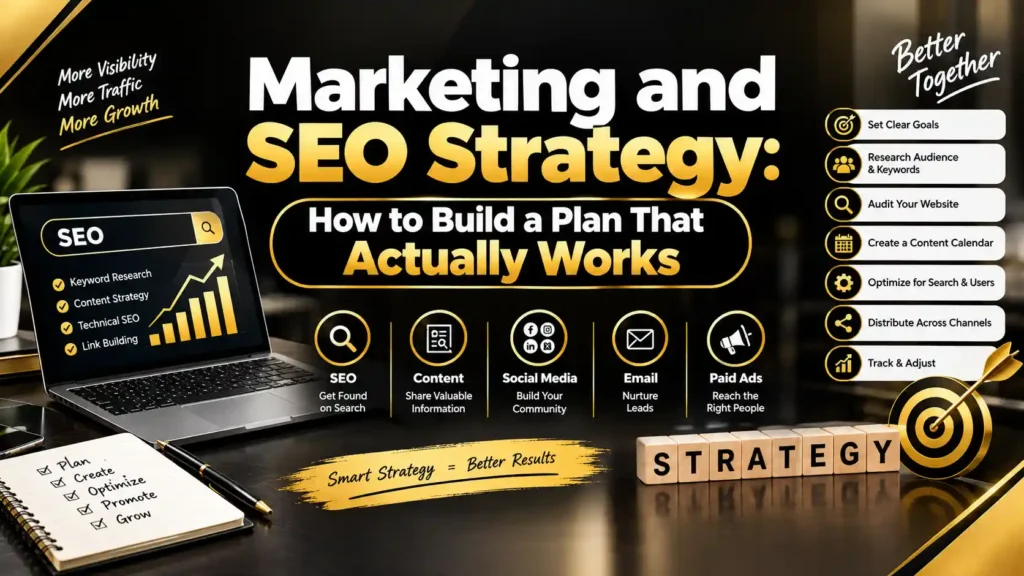
This kind of integrated strategy typically includes:
- Keyword and audience research : Understanding what your target audience searches for and what problems they’re trying to solve.
- Content planning : Creating blog posts, videos, and resources based on real search demand rather than guesswork.
- On-page and technical SEO : Making sure content and website structure are optimized so search engines can properly rank your pages.
- Social media alignment : Using top-performing SEO content and topics to fuel social media posts and engagement.
- Email marketing integration : Leveraging search intent data to craft more relevant, targeted email campaigns.
- Paid advertising coordination : Using organic keyword performance to inform which terms are worth targeting with paid campaigns.
When these elements work together rather than in silos, businesses typically see stronger, more consistent results than when each channel operates independently. If you want to understand the foundational concept behind this approach, our guide on What is Search Engine Optimization | A Complete Beginner’s Guide breaks down the SEO fundamentals that support this kind of integrated strategy.
How to Build an Effective Marketing and SEO Strategy
Building a strong marketing and SEO strategy doesn’t require a massive team or budget, but it does require a clear, organized approach rather than reactive, one-off efforts.
Steps to Create a Solid Marketing and SEO Strategy
Here’s a practical framework you can follow when building your own strategy:
- Define clear goals : Determine whether you’re focused on brand awareness, lead generation, sales, or a combination, since this shapes every other decision.
- Research your audience and keywords : Understand what your target customers are searching for and what stage of the buying journey they’re typically in.
- Audit your existing content and website : Identify what’s already working, what needs improvement, and any technical issues holding your site back.
- Create a content calendar : Plan topics based on keyword research, ensuring content aligns with real search demand rather than internal assumptions.
- Optimize for both search engines and readers : Structure content with proper headings, keywords, and formatting, while keeping it genuinely useful and readable.
- Distribute content strategically : Share content across social media, email, and other relevant channels to maximize its reach beyond organic search alone.
- Track and adjust regularly : Monitor performance data and refine your strategy based on what’s actually driving traffic, engagement, and conversions.
A well-structured marketing and SEO strategy treats these steps as an ongoing cycle rather than a one-time project. Search behavior, competition, and algorithms all shift over time, meaning your strategy needs regular attention to stay effective.
Common Mistakes That Weaken a Marketing and SEO Strategy
One of the most frequent mistakes is creating content and marketing campaigns in isolation, without checking whether they align with actual search demand. This often leads to wasted effort on topics nobody is searching for, no matter how well-written the content might be.
Another common issue is inconsistent publishing. A marketing and SEO strategy built around occasional bursts of content, followed by long gaps, rarely builds the momentum needed to see meaningful organic growth. Search engines and audiences both respond better to steady, predictable publishing over time.
Ignoring technical SEO is another mistake that can quietly undermine an otherwise solid strategy. Even the best content and marketing messaging can underperform if the website itself loads slowly or isn’t properly structured for search engines to crawl and index. If you’re unsure where your website currently stands, our guide on Check SEO for Website | A Simple Guide to Auditing Your Site walks through exactly how to evaluate your site’s technical health.
For a closer look at how these strategies come together in real campaigns, check out our YouTube channel, where we break down practical marketing and SEO strategy examples step by step.
If you found this guide helpful and want more practical marketing insights, follow our page on Facebook where we share regular strategies and case studies.
Final Thoughts
A strong marketing and SEO strategy isn’t about choosing one approach over the other it’s about making sure both work together toward the same goals. When SEO research shapes your content, and your content fuels social media, email, and paid advertising, every channel becomes more effective than it would be operating alone.
If your current marketing efforts feel disconnected from your SEO work, it’s worth taking the time to align them. Even small adjustments, like basing your content calendar on actual keyword research, can lead to noticeably stronger, more sustainable results across your entire marketing strategy.
1. What is a marketing and SEO strategy?
A marketing and SEO strategy is an integrated plan that combines search engine optimization with content, social media, and email marketing to attract traffic and generate leads or sales.
2. Why should SEO and marketing be combined into one strategy?
Combining SEO and marketing ensures channels support each other, using search data to inform content, social media, and paid advertising for more consistent, cost-effective results.
3. How do I start building a marketing and SEO strategy?
Start by defining clear goals, researching your audience and keywords, auditing existing content and your website, then building a content calendar based on real search demand.
4. How does content planning fit into a marketing and SEO strategy?
Content planning uses keyword research to create a calendar of topics that address real search demand, ensuring content has a genuine chance of being discovered.
5. Why is technical SEO important in a marketing and SEO strategy?
Technical SEO ensures your website is fast, mobile-friendly, and crawlable, since even great content and marketing can underperform on a poorly structured site.
6. How does email marketing connect to SEO strategy?
Search intent data from SEO helps craft more relevant, targeted email content and subject lines that align with what subscribers are actively interested in.


