What is Off Page SEO? A Complete Beginner’s Guide

If you’ve optimized every title tag, heading, and keyword on your website but you’re still struggling to rank against competitors, the missing piece is often something happening entirely outside your own site. Understanding what is off page SEO is is essential if you want to build the kind of authority and trust that search engines reward with higher rankings.
In this guide, I’ll explain exactly what off page SEO means, how it works, and what strategies you can use to build it effectively for your own website.
Quick answer: Off page SEO refers to actions taken outside your own website to improve its search engine rankings, primarily through building backlinks from other reputable sites, along with brand mentions, social signals, and other external trust indicators that signal authority to search engines.
What is Off Page SEO?
Off page SEO covers everything that happens away from your own website but still influences how search engines perceive its credibility and authority. While on-page SEO focuses on optimizing elements directly on your pages, off page SEO is about building a reputation across the wider internet that search engines can use as a trust signal.
Think of it like a letter of recommendation. You can write the most impressive resume in the world, but a strong recommendation from someone respected in your industry adds a layer of credibility that your own claims simply can’t provide. Backlinks and other off-page signals work similarly, telling search engines that other trusted sources vouch for your content.
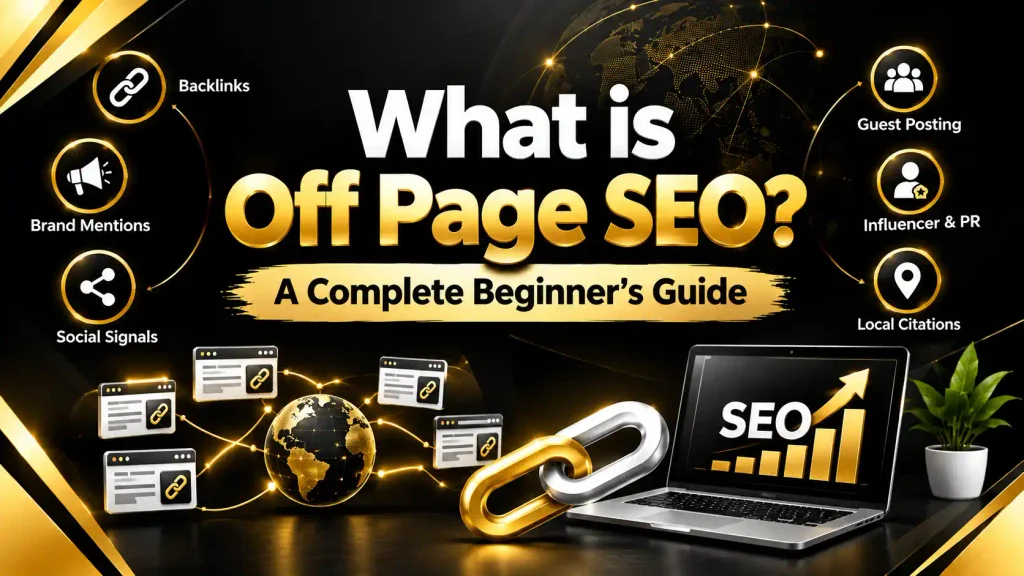
The main components of off page SEO typically include:
- Backlinks : Links from other websites pointing to your content, generally considered the most significant off-page ranking factor.
- Brand mentions : References to your business or website across the web, even without a direct link, which can still signal relevance and trust.
- Social media signals : Shares, engagement, and visibility across social platforms that indirectly support content discovery and brand awareness.
- Guest posting : Contributing content to other reputable websites in your industry, often including a link back to your own site.
- Influencer and PR outreach : Building relationships with industry figures or media outlets that can reference or link to your content.
- Local citations : Consistent business listings across directories, particularly important for local SEO efforts.
Each of these elements contributes to how authoritative and trustworthy your website appears in the eyes of search engines. If you want to understand how this connects with the optimization work you do directly on your website, our guide on What is On Page SEO | A Complete Beginner’s Guide covers the fundamentals of that complementary side of SEO.
Why Off Page SEO Matters for Your Rankings
Search engines use off page signals as a form of validation. While on-page SEO tells search engines what your content is about, off page SEO tells them whether other credible sources consider that content valuable enough to reference or recommend. This external validation is difficult to fake, which is exactly why it carries so much weight in ranking algorithms.
How Backlinks Influence Search Rankings
Backlinks remain one of the strongest ranking factors in most search engine algorithms, though not all backlinks carry equal weight. A link from a well-established, relevant website in your industry typically carries far more value than dozens of links from low-quality or unrelated sites.
Several factors influence how much value a backlink provides:
- Domain authority of the linking site : Links from established, trusted websites pass more authority than links from newer or lower-quality sites.
- Relevance to your content : A link from a site within your industry or niche carries more weight than one from a completely unrelated topic.
- Anchor text used : The clickable text of the link provides context to search engines about what your page is about.
- Link placement : Links within the main body of relevant content tend to carry more value than links buried in footers or sidebars.
- Number of other outbound links on the page : A page linking to dozens of other sites dilutes the value passed to each individual link.
Understanding these factors helps explain why quality matters significantly more than quantity when building backlinks. A handful of links from respected, relevant sources will typically outperform hundreds of low-quality links from spammy directories or link farms.
Common Off Page SEO Strategies That Actually Work
Building strong off page SEO takes time and genuine effort, but several strategies tend to produce reliable, sustainable results:
- Create genuinely link-worthy content : Original research, comprehensive guides, and unique data are naturally more likely to earn backlinks than generic content.
- Guest post on relevant, reputable sites : Contributing valuable content to established websites in your industry builds both authority and referral traffic.
- Build relationships within your industry : Networking with other website owners, bloggers, and journalists often leads to natural link and mention opportunities over time.
- Leverage digital PR : Getting featured in industry publications or news outlets can generate high-authority backlinks along with brand exposure.
- Encourage social sharing : While social signals aren’t a direct ranking factor, increased visibility often leads to more organic backlink opportunities.
- Fix broken link opportunities : Finding broken links on relevant websites and suggesting your own content as a replacement is a practical, often underused tactic.
If your off page efforts aren’t translating into better rankings, it’s worth checking whether technical issues on your own website might be holding you back. Our guide on What is Technical SEO | A Complete Beginner’s Guide explains the backend factors that can undermine even a strong backlink profile if left unaddressed.
Common Mistakes When Building Off Page SEO
One of the most damaging mistakes businesses make is pursuing low-quality, spammy backlinks in an attempt to quickly boost rankings. Search engines have become increasingly sophisticated at identifying manipulative link-building practices, and websites caught using these tactics risk penalties that can severely damage their visibility.
Another common mistake is focusing exclusively on the quantity of backlinks rather than their quality and relevance. A site with fifty highly relevant, authoritative backlinks will typically outperform a site with five hundred low-quality, irrelevant links, even though the numbers might initially seem to favor the larger volume.
Neglecting brand mentions and unlinked citations is another missed opportunity. Not every mention of your business needs a direct link to provide value; search engines increasingly consider brand mentions across the web as a trust signal, even without a clickable backlink attached.
It’s also common for businesses to treat off page SEO as a one-time project rather than an ongoing effort. Building genuine authority takes consistent work over months and years, not a short burst of link-building activity followed by silence. Sustainable off page SEO strategies focus on continuously creating value that naturally attracts attention and references over time.
Finally, some businesses focus entirely on off page SEO while neglecting the on-page and technical foundations that make backlinks actually effective. Even the strongest backlink profile won’t help much if the pages being linked to are poorly optimized, slow to load, or don’t genuinely satisfy what visitors are looking for.
For a more visual explanation of how backlink building and off-page strategies work in practice, check out our YouTube channel, where we break down real examples of successful off page SEO campaigns.
If you found this guide helpful and want more practical SEO strategies and case studies, follow our page on Facebook, where we share regular tips and updates.
Final Thoughts
Understanding what is off page SEO gives you a clearer picture of why some websites consistently outrank others despite having similar on-page optimization. By focusing on genuine, relationship-driven strategies like quality backlinks, digital PR, and brand mentions, rather than shortcuts or manipulative tactics, you build the kind of lasting authority that search engines are designed to reward.
If you’ve been focusing entirely on content and technical optimization while ignoring off-page efforts, it’s worth dedicating time to building genuine external relationships and earning credible references. Combined with strong on-page and technical SEO, a solid off-page strategy often makes the difference between content that ranks reasonably well and content that dominates search results for the long term.
1. What is off page SEO?
Off page SEO refers to actions taken outside your own website, primarily building backlinks and brand mentions, to improve how search engines perceive your site’s authority and rankings.
2. How is off page SEO different from on-page SEO?
On-page SEO involves optimizing elements directly on your website, while off page SEO focuses on external signals like backlinks and mentions from other sites.
3. Why are backlinks important for off page SEO?
Backlinks act as votes of confidence from other websites, signaling to search engines that your content is credible and valuable enough to reference.
4. Does the quality of a backlink matter more than quantity?
Yes, a handful of backlinks from authoritative, relevant sites typically outperforms hundreds of low-quality links from spammy or unrelated sources.
5. What is guest posting and how does it help off page SEO?
Guest posting involves contributing content to other reputable websites, often including a link back to your own site, building both authority and referral traffic.
6. What is the broken link building strategy?
This strategy involves finding broken links on relevant websites and suggesting your own content as a replacement, earning a natural backlink opportunity.


