What is On Page SEO? A Complete Beginner’s Guide
If you’ve spent time researching SEO, you’ve probably come across the term “on-page SEO” more times than you can count, often without a clear explanation of what it means. Understanding what is on page SEO is one of the most important first steps if you want your content to actually have a chance of ranking well.
In this guide, I’ll explain what on-page SEO involves, why it matters, and how you can start applying it to your own website or blog posts.
Quick answer: On-page SEO refers to the practices used to optimize individual web pages, including elements like title tags, meta descriptions, headings, keyword usage, internal linking, and content quality, so search engines can better understand and rank the page for relevant search queries.
What is on-page SEO?
On-page SEO covers everything you can control directly within a specific webpage to help it rank better in search results. Unlike off-page SEO, which focuses on external factors like backlinks, or technical SEO, which deals with the backend structure of your site, on-page SEO is entirely about optimizing the content and elements on the page itself.
Think of on-page SEO as making sure every part of a page clearly communicates what it’s about, both to readers and to search engines. When done well, it helps search engines understand your content’s relevance to specific queries, while also improving the actual experience for people reading it.
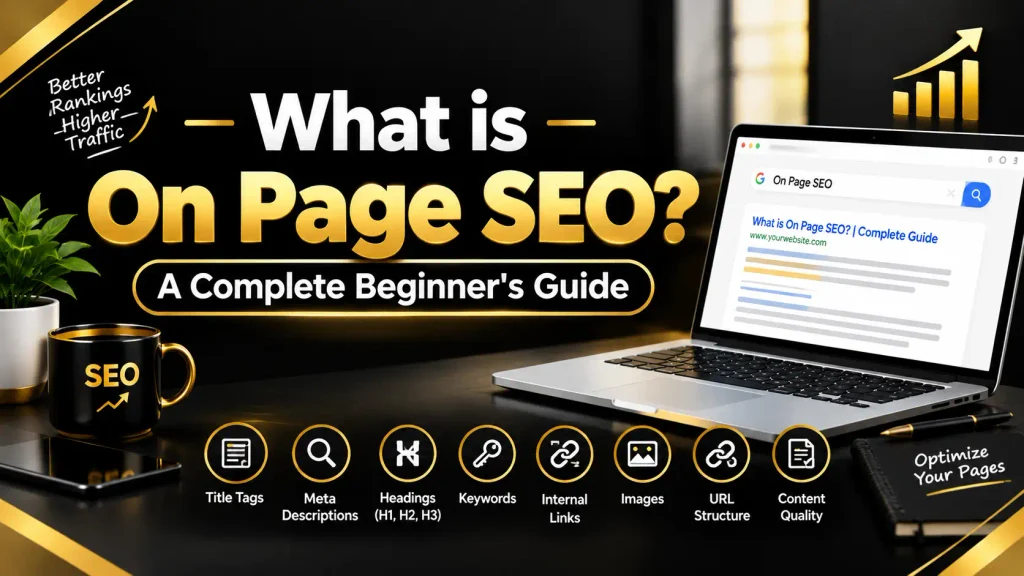
Here are the core elements that fall under on-page SEO:
- Title tags : The clickable headline in search results, ideally including your target keyword near the beginning.
- Meta descriptions : The short summary below the title in search results, encouraging users to click through.
- Header tags (H1, H2, H3) : Structuring content logically, with your main keyword in the H1 and naturally throughout subheadings.
- Keyword usage : Incorporating your target keyword and related terms naturally throughout the content, without overstuffing.
- Internal linking : Connecting related pages on your site to help both users and search engines navigate your content.
- Image optimization : Using descriptive file names and alt text so search engines understand what images represent.
- URL structure : Keeping URLs short, descriptive, and including relevant keywords where appropriate.
- Content quality and length : Providing genuinely useful, comprehensive information that fully answers the search query.
Each of these elements works together to signal relevance and quality to search engines. If you want to understand how this fits alongside the technical foundation of your website, our guide on What is Technical SEO | A Complete Beginner’s Guide explains the backend factors that support your on-page efforts.
How to Apply On Page SEO to Your Content
Now that you understand the concept, let’s walk through how to actually apply on-page SEO principles when creating or updating your content.
Key On Page SEO Practices for Better Rankings
Here’s a practical breakdown of what to focus on when optimizing a page:
- Write a compelling, keyword-rich title tag : Keep it under 60 characters and include your primary keyword near the start.
- Craft a clear meta description : Summarize the page’s value in around 140-155 characters, encouraging clicks without misleading readers.
- Use one clear H1 heading : Your H1 should include your main keyword and clearly reflect what the page is about.
- Structure content with H2 and H3 subheadings : Break longer content into scannable sections, using keywords naturally.
- Optimize your URL : Keep it short and descriptive, avoiding unnecessary numbers or special characters.
- Add internal links : Link to related content on your site to help both readers and search engines discover more pages.
- Optimize images : Compress file sizes for speed and add descriptive alt text for accessibility and relevance.
- Focus on content depth : Ensure your content genuinely answers the search query, rather than just hitting a word count.
A common mistake beginners make when learning what is on page SEO is focusing too heavily on keyword placement while neglecting actual content quality. Search engines have become significantly better at understanding context and user intent, meaning keyword stuffing often does more harm than good, both for rankings and for the reader’s experience.
On Page SEO vs Off Page and Technical SEO
It’s worth understanding how on-page SEO fits alongside the other two major SEO categories. On-page SEO controls what happens directly on your page, off-page SEO involves external signals like backlinks and brand mentions, and technical SEO ensures your website’s backend supports proper crawling and indexing.
All three work together, but on-page SEO is often the easiest place to start, since it’s entirely within your control and doesn’t require external cooperation from other websites. Getting your on-page fundamentals right also makes your off-page and technical efforts more effective, since well-optimized content gives search engines a clearer signal of relevance.
If your content strategy also touches on distribution and promotion, our guide on What is Content Marketing | A Simple Guide for Beginners explains how strong content and proper on-page SEO work together to attract and retain an audience.
For a visual walkthrough of optimizing a page step by step, check out our YouTube channel, where we demonstrate real on-page SEO improvements using actual website examples.
If you found this guide helpful and want more practical SEO tips, follow our page on Facebook where we share regular strategies and case studies.
Final Thoughts
Understanding what is on page SEO gives you direct control over one of the most important ranking factors available to you. By focusing on clear titles, well-structured headings, natural keyword usage, and genuinely valuable content, you create pages that both search engines and readers can easily understand and appreciate.
If you’ve been publishing content without much attention to on-page elements, revisiting your existing pages with these principles in mind can often lead to noticeable ranking improvements, even without creating anything new.
1. What is on page SEO?
On-page SEO refers to optimizing individual web pages using title tags, meta descriptions, headings, keywords, and content quality, so search engines can better understand and rank the page.
2. How is on-page SEO different from off-page SEO?
On-page SEO involves elements you control directly on your page, while off-page SEO relies on external signals like backlinks and brand mentions from other websites.
3. Why are title tags important for on-page SEO?
Title tags are the clickable headline in search results, and including your target keyword near the beginning helps both search engines and users understand relevance.
4. What is the ideal length for a meta description?
Meta descriptions should typically be around 140 to 155 characters, providing a clear, compelling summary that encourages users to click through to your page.
5. What is internal linking and why does it matter?
Internal linking connects related pages on your site, helping both users and search engines navigate your content and understand relationships between topics.
6. How does image optimization affect on-page SEO?
Using descriptive file names and alt text helps search engines understand what images represent, while also improving accessibility for visually impaired users.


