What is Web Development for Beginners | A Simple Starting Guide
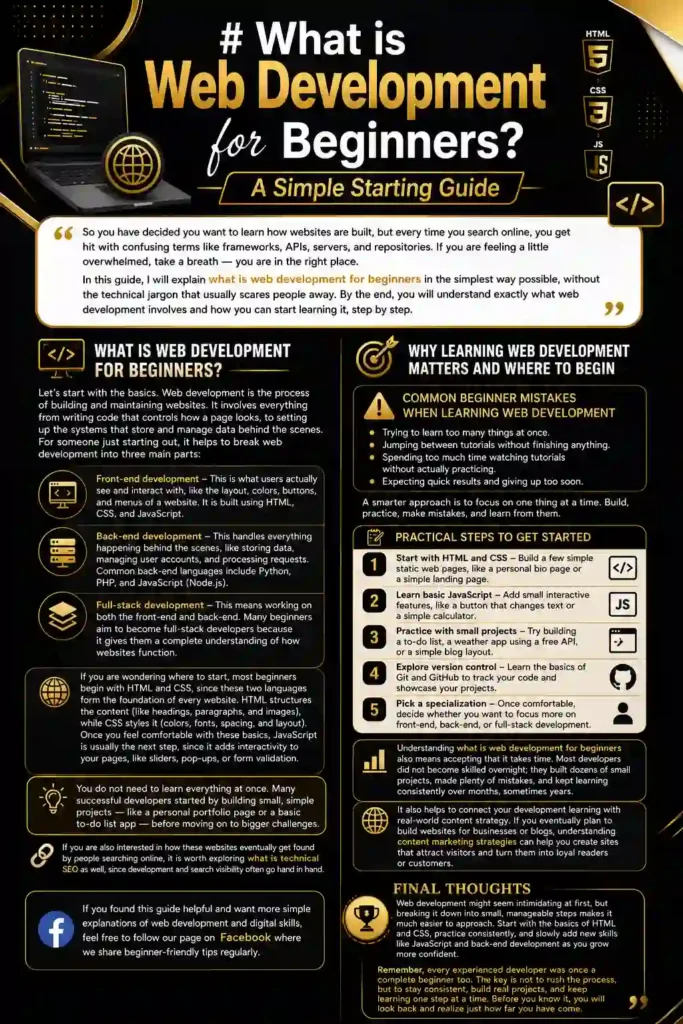
So you have decided you want to learn how websites are built, but every time you search online, you get hit with confusing terms like frameworks, APIs, servers, and repositories. If you are feeling a little overwhelmed, take a breath — you are in the right place.
In this guide, I will explain what is web development for beginners in the simplest way possible, without the technical jargon that usually scares people away. By the end, you will understand exactly what web development involves and how you can start learning it, step by step.
What is Web Development for Beginners?
Let’s start with the basics. Web development is the process of building and maintaining websites. It involves everything from writing code that controls how a page looks, to setting up the systems that store and manage data behind the scenes.
For someone just starting out, it helps to break web development into three main parts:
- Front-end development – This is what users actually see and interact with, like the layout, colors, buttons, and menus of a website. It is built using HTML, CSS, and JavaScript.
- Back-end development – This handles everything happening behind the scenes, like storing data, managing user accounts, and processing requests. Common back-end languages include Python, PHP, and JavaScript (Node.js).
- Full-stack development – This means working on both the front-end and back-end. Many beginners aim to become full-stack developers because it gives them a complete understanding of how websites function.
If you are wondering where to start, most beginners begin with HTML and CSS, since these two languages form the foundation of every website. HTML structures the content (like headings, paragraphs, and images), while CSS styles it (colors, fonts, spacing, and layout). Once you feel comfortable with these basics, JavaScript is usually the next step, since it adds interactivity to your pages, like sliders, pop-ups, or form validation.
You do not need to learn everything at once. Many successful developers started by building small, simple projects — like a personal portfolio page or a basic to-do list app — before moving on to bigger challenges.
If you are also interested in how these websites eventually get found by people searching online, it is worth exploring what is technical SEO as well, since development and search visibility often go hand in hand.
Why Learning Web Development Matters and Where to Begin
Now that you understand the basic definition, let’s talk about why this skill is worth learning and how you can get started, even with zero experience.
Common Beginner Mistakes When Learning Web Development
One of the most common issues for beginners is trying to learn too many things at once. People often jump between tutorials for HTML, then React, then Python, then a database system — all within the same week. This usually leads to confusion and burnout rather than real progress.
A smarter approach is to focus on one thing at a time. Spend a few weeks becoming comfortable with HTML and CSS by building simple static pages. Once you feel confident, move on to JavaScript basics. Only after that should you consider frameworks like React or back-end languages like Python or PHP.
Another common mistake is spending too much time watching tutorials without actually practicing. Web development is a hands-on skill, similar to learning to cook or play an instrument. Watching someone else code will only get you so far — you need to open your own code editor and build things yourself, even if you make mistakes along the way. In fact, mistakes are usually where the real learning happens.
Here are a few practical steps you can follow as a complete beginner:
- Start with HTML and CSS – Build a few simple static web pages, like a personal bio page or a simple landing page.
- Learn basic JavaScript – Add small interactive features, like a button that changes text or a simple calculator.
- Practice with small projects – Try building a to-do list, a weather app using a free API, or a simple blog layout.
- Explore version control – Learn the basics of Git and GitHub to track your code and showcase your projects.
- Pick a specialization – Once comfortable, decide whether you want to focus more on front-end, back-end, or full-stack development.
Understanding what is web development for beginners also means accepting that it takes time. Most developers did not become skilled overnight; they built dozens of small projects, made plenty of mistakes, and kept learning consistently over months, sometimes years.
The good news is that there are countless free resources available today, including YouTube tutorials, free coding platforms, and community forums where you can ask questions and get support from other learners.
It also helps to connect your development learning with real-world content strategy. If you eventually plan to build websites for businesses or blogs, understanding What is Website Development can help you create sites that are not just functional, but also built with a clear purpose in mind — attracting visitors and turning them into loyal readers or customers.
If you found this guide helpful and want more simple explanations of web development and digital skills, feel free to follow our page on Facebook where we share beginner-friendly tips regularly. Visite our youtube
Final Thoughts
Web development might seem intimidating at first, but breaking it down into small, manageable steps makes it much easier to approach. Start with the basics of HTML and CSS, practice consistently, and slowly add new skills like JavaScript and back-end development as you grow more confident.
Remember, every experienced developer was once a complete beginner too. The key is not to rush the process, but to stay consistent, build real projects, and keep learning one step at a time. Before you know it, you will look back and realize just how far you have come.
1. What is web development for beginners?
The process of building and maintaining websites, covering front-end, back-end, and full-stack development, including coding, design, and data management.
2. What are the three main parts of web development?
Front-end (what users see), back-end (behind-the-scenes systems), and full-stack (combining both front-end and back-end skills).
3. Where should a beginner start learning?
Start with HTML and CSS, since they form every website’s foundation, then move on to JavaScript for interactivity.
4. What is front-end development?
Building what users see and interact with layout, colors, buttons, menus using HTML, CSS, and JavaScript.
5. What’s the biggest mistake beginners make?
Trying to learn too many things at once jumping between HTML, React, Python, and databases which causes confusion and burnout.


